Wehrpass:Gerhard Lähne: Difference between revisions
Added Text |
mNo edit summary |
||
| (4 intermediate revisions by the same user not shown) | |||
| Line 1: | Line 1: | ||
{| class="infobox" style="width: 25em; font-size: 90%; text-align: left; border-collapse: collapse;" | {| class="infobox" style="width: 25em; font-size: 90%; text-align: left; border-collapse: collapse;" | ||
|- | |- | ||
| Line 30: | Line 31: | ||
| style="padding: 0.35em;" | ''Wehrpass'' | | style="padding: 0.35em;" | ''Wehrpass'' | ||
|} | |} | ||
<gallery> | |||
File:Image-4-jun-2026-13 34 07.png|Front of Wehrpass | |||
File:ChatGPT-Image-4-jun-2026-13 34 11.png|Page 1 of Wehrpass | |||
File:Image-4-jun-2026-13 34 16.png|Photo page of Wehrpass | |||
File:Image-4-jun-2026-13 34 25.png | |||
File:Image-4-jun-2026-13 34 29.png | |||
File:Image-4-jun-2026-13 34 36.png | |||
File:Image-4-jun-2026-13 34 53.png | |||
File:Image-4-jun-2026-13 35 01.png | |||
File:Image-4-jun-2026-13 35 14.png | |||
</gallery> | |||
'''Gerhard Lähne''' was a German physician who served in the Luftwaffe medical service during the Second World War. His surviving ''Wehrpass'' records his initial service with an anti-aircraft artillery unit, his subsequent training as a medical-officer candidate, his assignments to medical and Flak formations, and his release from active service in June 1942. | '''Gerhard Lähne''' was a German physician who served in the Luftwaffe medical service during the Second World War. His surviving ''Wehrpass'' records his initial service with an anti-aircraft artillery unit, his subsequent training as a medical-officer candidate, his assignments to medical and Flak formations, and his release from active service in June 1942. | ||
| Line 240: | Line 252: | ||
== Source == | == Source == | ||
* ''Wehrpass'' of Gerhard Lähne, private collection. Selected pages photographed and examined for Sanitäter.eu. | * ''Wehrpass'' of Gerhard Lähne, private (Sanitäter.eu's) collection. Selected pages photographed and examined for Sanitäter.eu. | ||
== See also == | == See also == | ||
| Line 257: | Line 269: | ||
[[Category:Wehrpass documents]] | [[Category:Wehrpass documents]] | ||
[[Category:Sanitäter.eu document archive]] | [[Category:Sanitäter.eu document archive]] | ||
[[Category:Wehrpass]] | |||
Latest revision as of 20:06, 6 June 2026
| Gerhard Lähne | |
|---|---|
| Full name | Gerhard Lähne |
| Additional given names | Walter and Johannes Template:Small |
| Born | 23 May 1910 |
| Birthplace | Leipzig, Germany |
| Civilian profession | Physician (Arzt) |
| Marital status | Unmarried (ledig) at the time of registration |
| Branch | Luftwaffe |
| Medical status | Medical-officer candidate; later Unterarzt d.B. |
| Document | Wehrpass |
-
 Front of Wehrpass
 -
 Page 1 of Wehrpass
 -
 Photo page of Wehrpass
 -

-
-

-

-

-


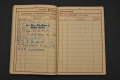
Gerhard Lähne was a German physician who served in the Luftwaffe medical service during the Second World War. His surviving Wehrpass records his initial service with an anti-aircraft artillery unit, his subsequent training as a medical-officer candidate, his assignments to medical and Flak formations, and his release from active service in June 1942.
The document is particularly interesting because it illustrates the wartime career of a medically qualified reservist. Lähne was not simply recorded as a general medical orderly or Sanitäter. His civilian profession was physician (Arzt), and the later entries show his progression through the medical-officer candidate system.
Early life
Gerhard Lähne was born in Leipzig on 23 May 1910. His Wehrpass records Leipzig as both his place of birth and administrative district.
His full given names appear to have been Gerhard Walter Johannes Lähne, although the handwritten middle names should be treated as a provisional reading. Elsewhere in the document, the shorter form Gerhard Lähne is used.
At the time his personal details were entered, Lähne was unmarried. His civilian profession was recorded as:
This means physician or medical doctor.
His educational entry appears to refer to an Abiturzeugnis, indicating completion of the secondary-school qualification normally required for university study.
Registration and initial assessment
Lähne was medically examined and registered as a volunteer (Freiwilliger) on 26 June 1936.
The assessment on the mustering page records him as:
This indicated that he was considered fit for military service at the time of examination.
The document also records a driving licence and related civilian information. These details were relevant because medical personnel could be assigned duties requiring mobility, including work with evacuation or transport units.
Initial military service
Lähne began active service on 26 October 1936.
His initial unit is recorded as:
12. Batterie
Flak was the commonly used abbreviation for Flugabwehrkanone, meaning anti-aircraft gun. The unit therefore belonged to the anti-aircraft artillery arm of the Luftwaffe.
The service-entry page shows that his active service counted from 26 October 1936. A later unit-history entry records his assignment to 12./Flak-Regiment 12 until 19 December 1936.
Medical-officer training
An especially important entry appears on the training page of the Wehrpass. A large stamped entry records:
vom 2. Jan. – 28. Febr. 1940“
This can be expanded as:
from 2 January to 28 February 1940
The abbreviation San. Offz. Anw. stands for Sanitätsoffizier-Anwärter, or medical-officer candidate.
This entry confirms that Lähne’s wartime role was not limited to general medical duties. As a qualified physician, he underwent a course intended to prepare him for service within the military medical-officer structure.
Promotion and appointment as Unterarzt
The promotions page contains several stamps and handwritten entries. Among the clearest are:
- Uffz. d.B.;
- Unterarzt d.B..
The abbreviation Uffz. stands for Unteroffizier. The addition d.B. stands for des Beurlaubtenstandes, indicating reserve or non-active personnel status.
The title Unterarzt was a medical-officer candidate rank. It should not be confused with the higher commissioned medical ranks such as Assistenzarzt, Oberarzt, or Stabsarzt.
The appointment as:
shows that Lähne had entered the military medical career structure as a qualified physician in the reserve establishment.
The precise dates of all intermediate rank changes should be checked against higher-resolution scans before a definitive transcription is published. The date associated with the Unterarzt d.B. entry appears to be in 1940.
Wartime unit assignments
The unit-history page records a sequence of assignments during the war. Some entries are clearly legible, while others remain partly obscured by handwriting or abbreviations.
The following provisional timeline can be reconstructed:
| Period | Unit or posting | Notes |
|---|---|---|
| 26 October 1936 – 19 December 1936 | 12./Flak-Regiment 12 | Initial active service with a Luftwaffe anti-aircraft artillery unit |
| January 1940 – early March 1940 | Ers.-San.-Komp. 6, Münster (Westf.) | Probably Ersatz-Sanitäts-Kompanie 6; the medical-officer candidate course took place during this period |
| 1940 | Medical or sanitary unit entry, partly illegible | Further examination of the original document is needed |
| From 1940 | Res. Flak-Abt. 146 | Reserve anti-aircraft artillery battalion |
| 1941 | Additional medical or Luftwaffe posting, partly illegible | Reading uncertain |
| 1941–1942 | Res. Flak-Abt. 511 | Reserve anti-aircraft artillery battalion |
| 1942 | Sanitary or staff-related posting connected with Flak service | Exact reading uncertain |
| 20 June 1942 | A. u. E.-Stelle (V) VI | Annahme- und Entlassungsstelle; administrative acceptance and discharge office |
The assignments indicate that Lähne’s medical duties were closely connected with Luftwaffe anti-aircraft units. Flak formations protected important military, industrial, and logistical targets from air attack. A physician attached to such formations could be responsible for medical care within the unit and for the treatment or evacuation of casualties.
Recorded wartime service
The campaign and operational-service page contains several handwritten entries. One of the clearest describes participation in:
im Heimatkriegsgebiet“
This means:
within the home war zone
This entry fits Lähne’s recorded service with Luftwaffe Flak units. Anti-aircraft formations were deployed to protect strategically important sites such as industrial areas, transport hubs, airfields, and other infrastructure.
A later entry records:
meaning:
The date range appears to begin in January 1942 and end in May 1942. Some of the subsequent handwriting is difficult to read because it overlaps with stamps. It appears to concern further duties in the Mediterranean theatre and may include references to the movement or care of wounded and sick personnel. This interpretation should remain provisional until the entry has been examined more closely.
Release from active service
A clearly stamped entry on page 26 records Lähne’s release from military service on:
The entry reads:
The abbreviation Uk-Stellung refers to an Unabkömmlichstellung: a release or exemption based on the individual being considered indispensable for an important civilian role.
The same page records the medical assessment:
The abbreviation k.v. means kriegsverwendungsfähig, or fit for wartime service.
Lähne was therefore not released because he was medically unfit. The document instead indicates that he was discharged for an Uk-Stellung. As a trained physician, his civilian medical work may have been considered important enough to justify his release from active duty. The surviving photographed pages do not identify his civilian employer or the precise reason for the decision.
Historical significance of the Wehrpass
Gerhard Lähne’s Wehrpass illustrates the varied paths followed by German medical personnel during the Second World War.
His record differs from that of a frontline medical orderly. Lähne was already a civilian physician. He received military training, served initially with an anti-aircraft artillery unit, attended a medical-officer candidate course, and was appointed Unterarzt d.B.
The document also demonstrates that medical personnel could move between different organisational settings. Lähne’s assignments included Luftwaffe Flak units, medical training establishments, reserve formations, and administrative offices.
His release in June 1942 is also noteworthy. It shows that military authorities sometimes had to balance the need for doctors within the armed forces against the need for physicians in civilian life or other essential services.
Transcription notes
This article is based on photographs of selected pages from the surviving Wehrpass. Several handwritten entries are difficult to decipher and should be treated cautiously.
The following points are considered reasonably secure:
- the surname Lähne;
- the commonly used first name Gerhard;
- the date of birth: 23 May 1910;
- the birthplace: Leipzig;
- the civilian profession: Arzt;
- initial service with 12./Flak-Regiment 12;
- attendance at the second medical-officer candidate course from 2 January to 28 February 1940;
- the appointment as Unterarzt d.B.;
- service with reserve Flak formations;
- recorded deployment in the Mediterranean area;
- discharge for an Uk-Stellung on 20 June 1942.
The following readings remain provisional:
- the additional given names;
- several intermediate unit assignments;
- some of the dates on the promotions page;
- the complete wording of the Mediterranean-theatre entry;
- the precise civilian reason for the Uk-Stellung.
Further photographs or scans may allow these entries to be transcribed more accurately.
Source
- Wehrpass of Gerhard Lähne, private (Sanitäter.eu's) collection. Selected pages photographed and examined for Sanitäter.eu.

